![]() |
| Hard at work |
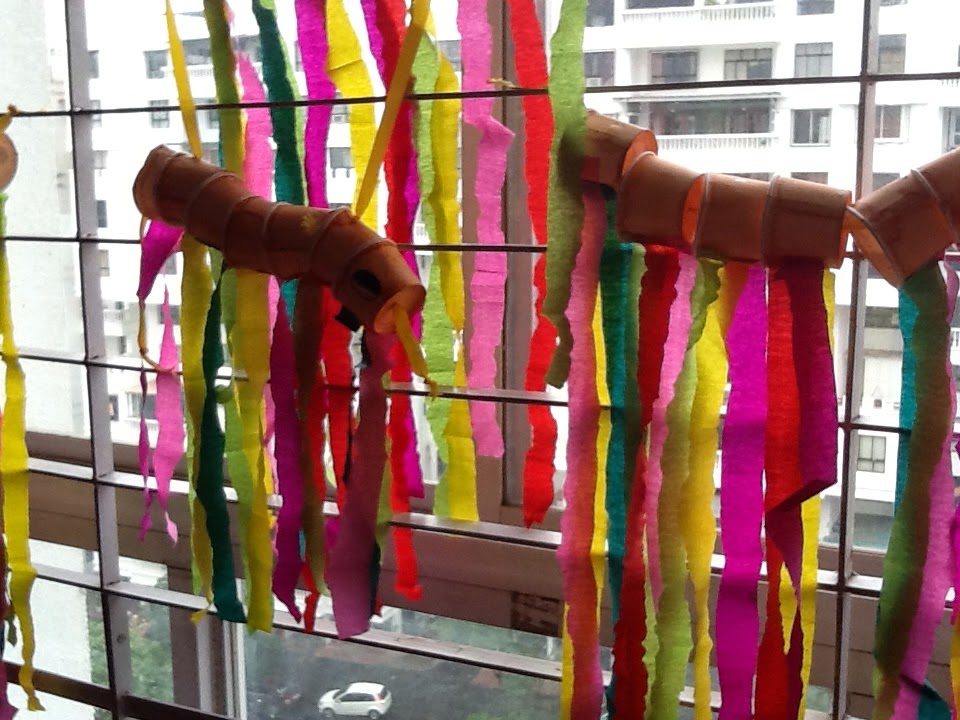
This is what they looked like.. Not very ‘scary dragonish’ but dragons nonetheless. As one of the kids put it, ‘It doesn’t need to look scary since the dragon of our story was a nice one.’ Which was of course undebatable!


Notes from an almost-empty-nester
![]() |
| Hard at work |
This is what they looked like.. Not very ‘scary dragonish’ but dragons nonetheless. As one of the kids put it, ‘It doesn’t need to look scary since the dragon of our story was a nice one.’ Which was of course undebatable!

Many times I have tried to make peace but convincing a group of 11- 12 year olds to give up prejudices, however temporary, is hard. After N came home on two consecutive days crying since the girls had ‘boycotted’ her for some reason I decided to do something about it. In no way am I implying she’s always a victim. I am sure there are days she’s at the other end too.
..is a craft activity : Making a dragon
and a brand new story.
2. If you can think of book related activities drop me a line.
She was born in London to a British father and Jamaican mother who migrated to Britain in 1969. She was christened Sadie Smith. At 14 she changed her name to Zadie. Interestingly a love for music runs in the family as two of her younger brothers are rappers.
… was the stuff of fairy tales. At the University while studying English Literature she published a few short stories for a collection of new student writing called Mays Anthology. A publisher read those stories and offered her a contract for her first book, which made her go in search of a literary agent. Seems like a dream debut, doesn’t it?
On the basis of a partial manuscript her book was auctioned among publishers. During her final year at Cambridge she finished her book, White Teeth. It was an runaway success. So overwhelmed was she that she went into a writer’s block. “I think (the success of this book is) a surprise which will last me my whole life,” she said in an interview. Her second book Autograph Man also proved to be a success.
…began as a short story except it was hardly short, more of a Novella. And so she decided to expand it into a full sized novel. It spans three generations telling the story of two friends, World War II veterans Archie and Samad. It follows their lives and then of their children who pick varied paths in life. It touches upon issues of immigrants, war, religion and friendship. I liked the way the book jumps back and forth between England, Jamaica and Bangladesh bringing it all alive through vibrant descriptions.
Isn’t that heartening? Perhaps it IS okay to do things your own way and follow no one at all. So it doesn’t matter that Enid Blyton wrote 10,000 words a day in her ‘red’ room, or that Ian Fleming needed to get away to Jamaica each year to get that novel done, or that Dahl moved to his tiny shed away from the house. All one needs to do to become a writer is do things her own way and write from the heart.
And finally that’s The End! The April A to Z Challenge ends today and I really have no idea what I’ll do with myself. Looking forward to visiting all you lovely people now.
Though born a Chinese, English is her chosen language of expression. Yiyun Li was born in Beijing China. As a student of Immunology she moved to America for further studies in 1996 intending to become a researcher just like her parents wanted her to. She had never written anything and writing was far from her mind.
During her days in America she attended an evening community writing class. She followed it up with more classes. Meanwhile she wrote some short stories. One of her stories, Immortality, was read by the Pulitzer Prize winning author Alen Mc Pherson. He was so excited he tracked Li down through a friend and sent a message saying she must continue too write. That made up her mind for her. A writer she did become.
Short stories and more..Yiyun Li draws her subjects from China. Most of her stories are about small powerless people. Perhaps that’s why they are often cynical, tragic and frustrating. Her first book, which includes the story, Immortality, was a short story collection titled A Thousand Years of Good Prayers. I like her stories but more than that I like the glimpse of China she offers. Bits of history, the mood of the people, life under a dictatorship – all of that woven together in heat rending tales. Her writing is richly sprinkled with Chinese mythology and Chinese proverbs that she translates into English lending it a quaint quality.
Set in the 1970s The Vagrants is her debut novel. It opens with the gruesome hanging of a young woman and goes on to explore how different people in the city react to it. This one is no cheerful read, nor is it for those with weak stomachs. You despair as you find the eyes of dictatorship everywhere, corrupting everything and everyone, allowing for no escape. It reminded me a bit of George Orwell’s 1984. This one however is way more gruesome and graphic in gory detail. Not really my kind of book.
…Li refuses to release her books. They have been translated into over 20 languages but not in her native Mandarin. In a number if interviews she has said she feels China is not ready for her books just as much a she is not ready for them to be read in her country of birth.
Talking about whether her books represent China and its way of life she says, “It’s never my job to explain China.. We never ask an American writer to represent America or a British writer to represent Britain.” Yet it seems unavoidable that her characters are taken to depict China. Reminds me how Pearl Buck’s The Good Earth has come to represent China of another age.
And finally it’s time for the last post tomorrow. This last author, is half British, half Jamaican and aspired to be an actress before the literary world beckoned.

From a young teen who didn’t know a word of English to teaching it as a professor in an English speaking country and becoming an award winning author.. how’s that for progress? As a young boy Ha Jin joined the People’s Liberation Army. By the time he was 17 he was teaching himself the high-school course. In his late teens he joined an English Learner’s Programme only because he wanted to read, in original, Friedrich Engels’ book ‘The Condition of the Working Class in England in 1844′. At the University he was assigned English as a major despite it being his last choice. Later he went on to study in America and stayed on after the Tienanmen Massacre. His books ‘Waiting’ and ‘War Trash’ won various awards.
He was a true multilinguist. Born an Irishman he is one of the most famous novelist, poet, playwrite and theatre director. He had degrees in French and Italian. His works, at least initially were very strongly influenced by friend and fellow Irishman James Joyce who was similarly qualified and equally well-known. Beckett is known for his black comedy and a rather tragic take on human nature. He began writing in English. After the Second World War he switched to French. He said French allowed him to write in much simpler form and let him ‘escape the habits’ of English writing. His French works are thus rather minimalistic. In 1956 he returned to English and then on wrote his works in both languages. He translated his own works too. He is perhaps the only author whose entire works exist in two languages and also one who wrote simultaneously in two languages. Each time he translated his works, he revised them. What an interesting read it would be if one were to compare the same works in the two different languages!

He was Polish by birth and couldn’t even speak English fluently till his late twenties and even then with a strong Polish accent (which is why he could never take on teaching assignments). It was his third language after Polish and French. Conrad never finished school however he left with a knowledge of Latin, German and Greek along with Polish and French. He was fluent in the the latter two. He picked up English while working aboard a British ship from his shipmates. He was hired to take a steamship to Africa and was so appalled by the horrors inflicted by colonial rule that he felt he had to write about them and the fictional account turned into a book – Heart of Darkness. His works offer glimpses of French, Polish and Russian literature. He once commented, “English is so plastic – if you haven’t got a word you need you can make it, but to write French you have to be an artist.”
Isn’t that just the opposite of what Beckett said? And this is what I find so very interesting about authors. I love the way they perceive languages, the way they find their comfortable linguistic corners and come with startling works.
Personally, since I do not know French, I would go with Conrad. Living in India learning English has come to me quite as naturally as Hindi, my mother tongue and our national language. It is indeed one of the most pliant languages, absorbing diverse slangs, adapting multilingual words making them it’s own and allowing people world over to make it their own too. And so we have American English, British English and Australian English. Back home in India we have Hinglish, Punglish and scores of South Indian versions.
Tomorrow I bring for you another Exophoric author from China. Her books are rather dark, even gory yet the glimpse of China they offer is priceless. Stay tuned.